
NATIONAL SPATIAL DEVELOPMENT PLANNING: [ARTICLE 5] TRANSIT-ORIENTED DEVELOPMENT (TOD)
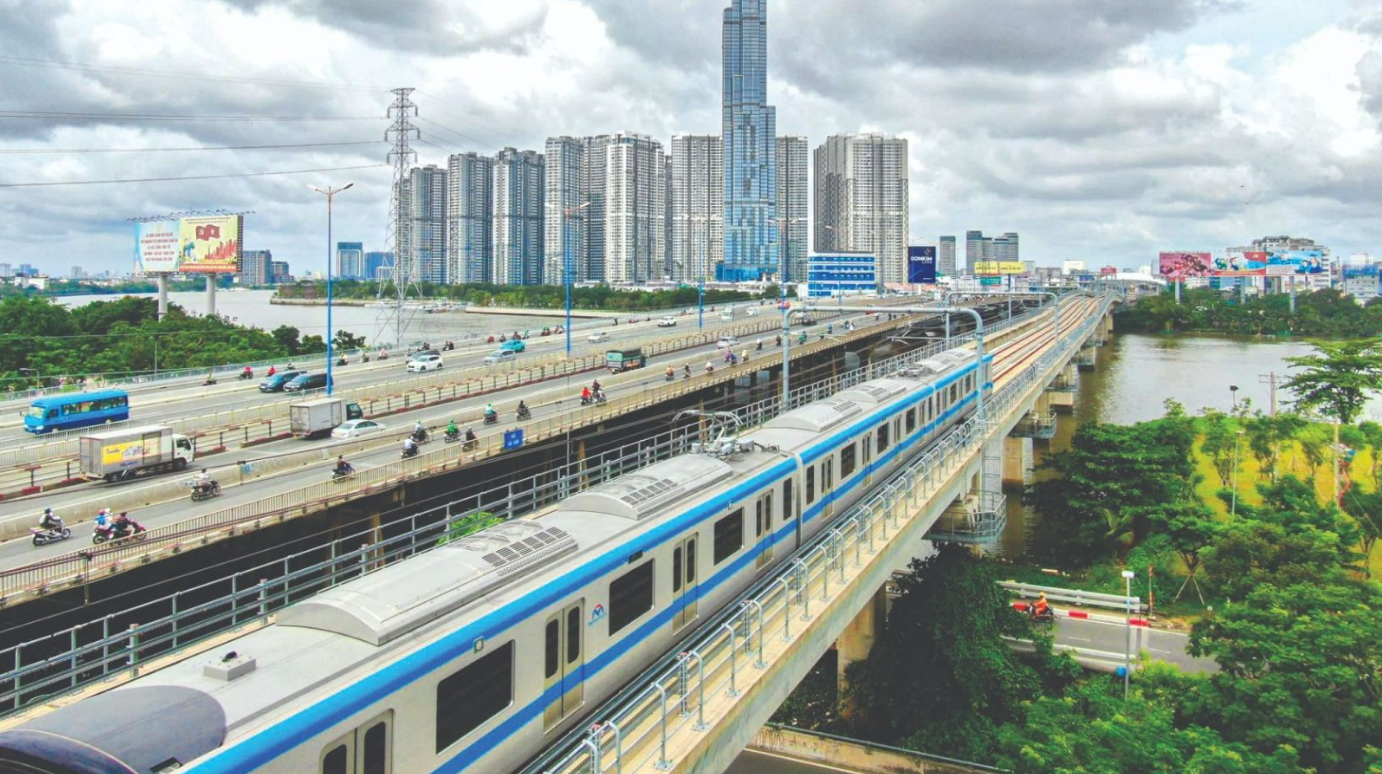
Transit-Oriented Development (TOD) has become a key solution for implementing Vietnam’s national spatial development strategy amid rising fiscal pressure.
In practice, land-related revenue has increased rapidly, from VND 128.7 trillion in 2015 to over VND 209.4 trillion in 2020 — an increase of approximately 1.6 times — and reached VND 575.5 trillion in 2025, nearly 2.7 times higher than in 2020 and about 4.5 times higher than in 2015.
Transit-Oriented Development (TOD) concentrates high-density urban development around transit stations in order to leverage financial and institutional structures capable of transforming land value appreciation generated by infrastructure investment into sustainable funding sources for transportation and urban development. The integration of SEEA, LADM, and IFC frameworks enables the identification, modeling, and valuation of resources within multi-layered spatial systems, thereby mobilizing TOD resources, supporting land valuation frameworks based on value zones, enhancing fiscal transparency, and ensuring long-term sustainable development.

International Lessons
Mobilizing resources for TOD linked to national spatial planning requires a long-term approach built upon the close relationship between mass transit infrastructure, land markets, urban finance, and the state’s coordination capacity.
International experience shows that TOD is not simply about concentrating density around stations; rather, it is a financial and institutional structure that allows land value appreciation to be transformed into sustainable capital for infrastructure investment, urban regeneration, and improved quality of life. East Asian countries, characterized by high population density, strong public transport culture, and mature real estate markets, have developed highly systematic TOD models that offer valuable lessons for Vietnam.
In Japan, the integration of private railways and urban redevelopment emerged during the postwar period as part of the long-term business strategy of private railway corporations. Tokyu Corporation is considered a representative case, viewing railways not merely as transport systems but as the backbone for urban spatial development. Over several decades, Tokyu proactively secured suburban land around Tokyo before constructing railway lines, then applied land readjustment mechanisms to reorganize urban space, allocate land for infrastructure, parks, housing, and commercial districts. The increase in land value following planning became a major source for offsetting railway investment costs, which typically generate low profit margins. This approach highlights the critical importance of land control before infrastructure development in order to prevent speculation from eroding the financial capacity of land value capture mechanisms.
Lessons from Shinkansen stations such as Shin-Yokohama Station demonstrate the importance of timing in TOD implementation. Initially, the station existed in a largely agricultural area and experienced slow development for decades. However, once urban transit connections and increased high-speed rail frequency were introduced, the surrounding area rapidly transformed into a major office, hotel, and entertainment hub. Public land prices surged even while national land prices declined overall. This case demonstrates that TOD around newly developed stations requires policy patience, multimodal connectivity, and integrated planning rather than short-term occupancy expectations.
Hong Kong provides a global benchmark for TOD financing through its “Rail + Property” model. MTR Corporation was granted rights to develop land above and around stations based on pre-infrastructure valuations, then partnered with private developers to commercialize projects at post-infrastructure market prices. The resulting land value uplift became the primary funding source for railway construction and operations, reducing dependence on government budgets. This model requires flexible legal frameworks for land valuation, transparent benefit-sharing mechanisms, and strong governance capacity within state-owned enterprises.
Taiwan offers another important lesson through development zones surrounding high-speed rail stations. The strategy of locating stations outside city centers to reduce land clearance costs and stimulate new urban development only succeeded in economically dynamic areas such as Hsinchu and Taoyuan. Stations lacking strong economic foundations experienced prolonged underdevelopment, resulting in disappointing real estate revenues and financial crises in BOT projects that ultimately required government intervention. This experience demonstrates that TOD must be linked to clear economic anchors in order to avoid spreading resources too thinly.
Comparisons with Singapore, South Korea, and China further highlight the dominant role of the state in land control, density planning, and land value capture. Singapore reinvests revenue from high-density land sales around MRT stations back into infrastructure, creating a closed financial cycle. South Korea applies large-scale land readjustment mechanisms supported by central government budgets and specialized state-owned enterprises. China mobilizes land finance through urban development corporations and development rights above metro stations, generating significant revenue for network expansion.
International experience consistently shows that TOD success depends on controlling land acquisition timing and selecting appropriate development drivers for each station. Japan’s Shinkansen model demonstrates that new stations may require decades to accumulate sufficient economic momentum, requiring long-term policy vision and patient land asset management. Hong Kong highlights the effectiveness of asset-based development when railway corporations are granted land development rights before infrastructure construction, enabling them to retain most of the generated value appreciation. Taiwan serves as a warning against dispersed investment at stations lacking economic foundations, which can lead to financial crises and budgetary intervention.
At the same time, TOD development must be integrated into national spatial planning, with a focus on institutional reform in land management, urban finance, and intersectoral coordination. Controlling land banks prior to infrastructure investment, establishing transparent land value capture mechanisms, selecting station locations linked to real economic drivers, and maintaining a long-term vision are all critical conditions for mobilizing social resources and ensuring the financial sustainability of public transport infrastructure.
Potential Application to Vietnam’s North–South High-Speed Railway
Vietnam’s North–South High-Speed Railway represents a project whose scale of investment, spatial reach, and economic impact far exceed previous transportation projects. Stretching 1,541 kilometers between Hanoi and Ho Chi Minh City, the railway will pass through 20 provinces and cities, operate at speeds of 350 km/h, use a standard 1,435 mm gauge, and be fully electrified, with the goal of reducing North–South travel time to under six hours.
The estimated investment of USD 67.34 billion places enormous pressure on national fiscal balances amid growing spending demands for social welfare, energy transition, and climate adaptation. As the project is expected to rely primarily on domestic public investment, there is an urgent need for additional financing mechanisms, making TOD a strategic pillar rather than merely a supporting planning solution.
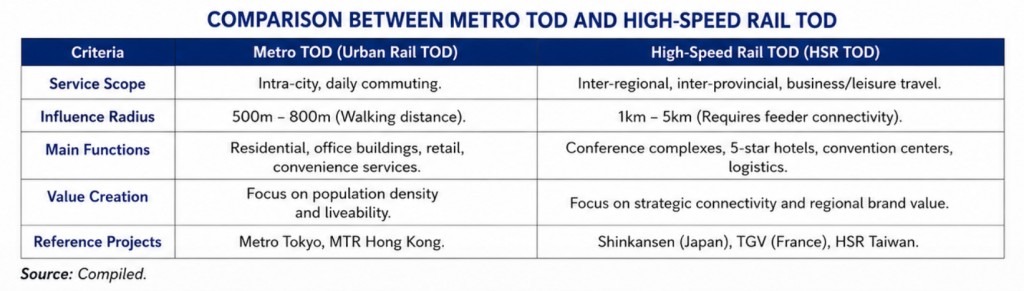
TOD associated with high-speed rail differs fundamentally from TOD linked to inner-city metro systems. High-speed rail stations function as regional gateways capable of restructuring urban economic geography. As travel time between major centers is compressed, intermediate cities such as Vinh, Nam Dinh, Phan Thiet, and Nha Trang could directly participate in the economic value chains of Hanoi and Ho Chi Minh City.
The core value of TOD lies in its ability to generate substantial land value premiums around station areas through public infrastructure investment. The additional value created — which is not generated by individual landowners — should be recaptured through institutional mechanisms and reinvested into national infrastructure.
Vietnam’s 2024 Land Law formally recognizes areas surrounding transport hubs and allows the state to acquire land for auction and urban development linked to infrastructure. Meanwhile, the revised Railway Law introduces a revenue-sharing mechanism in which land development revenues from surrounding areas are split 50/50 between the central government and local authorities, creating stronger financial incentives for provinces to participate proactively in land clearance, infrastructure investment, and planning adjustments.
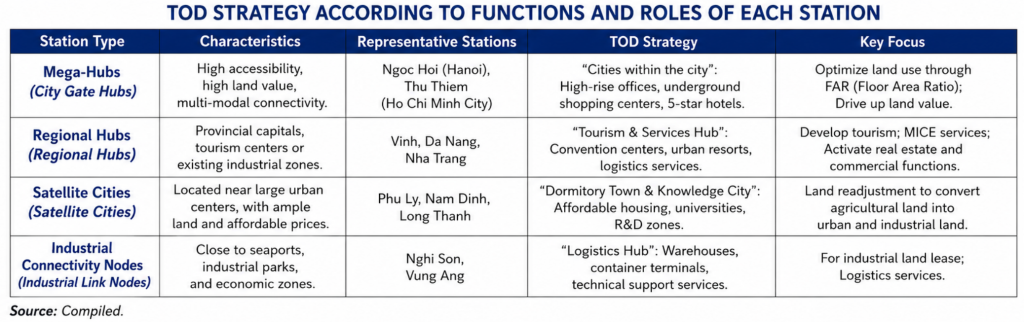
Vietnam cannot apply a single TOD model uniformly across all 23 stations along the North–South corridor. Gateway stations in mega-urban regions such as Ngoc Hoi and Thu Thiem should prioritize high-density financial, commercial, and premium service functions to maximize land use efficiency and generate rapid revenue. Regional centers such as Da Nang, Nha Trang, and Vinh are more suitable for TOD models linked to tourism, conference services, and high-quality logistics. Satellite cities such as Phu Ly, Nam Dinh, and Long Thanh should prioritize affordable housing, research centers, and educational facilities while applying land readjustment to transform agricultural land into urban land while protecting local livelihoods.
The financial strategy for the high-speed railway should adopt a multilayered structure in which TOD serves as both a counterpart funding source and a long-term repayment mechanism. Central government budgets and sovereign bonds would continue financing the core rail infrastructure, while private investors would participate in rolling stock, station development, and commercial complexes through PPP models. Revenue generated from land-use rights auctions in surrounding areas could then offset land clearance costs and contribute to central government revenues under the legislated sharing mechanism.
The greatest risks in implementation include land speculation, planning conflicts between sectors, and limited real estate absorption capacity when large supplies enter the market simultaneously. Governance measures should therefore focus on strict zoning controls immediately after project approval, regulating land transfers within planning zones, phasing land auctions according to market demand, and prioritizing high-potential stations first.
If implemented with strong institutional discipline and a long-term vision, the TOD urban corridor along the North–South High-Speed Railway could become a new engine of development, transforming land resources into a sustainable financial foundation for national infrastructure and reshaping Vietnam’s spatial development for decades to come.
Assoc. Prof. Dr. Nguyen Dinh Tho
Institute of Strategy and Policy on Agriculture and Environment

Tác giả: Admin
Một thành viên của VSCE.