
NATIONAL SPATIAL DEVELOPMENT PLANNING: [ARTICLE 4] NATURAL RESOURCE VALUATION

National spatial development planning based on an ecosystem landscape approach places land and natural resources at the center of development structures and fiscal systems.
In 2015, total revenue from land and housing-related fees reached VND 128.7 trillion, reflecting a period in which land resources were heavily utilized to balance budgets and finance infrastructure investment. By 2020, land-related revenue exceeded VND 209.4 trillion — approximately 1.6 times higher than in 2015 — driven by urban expansion and industrialization. In 2025, total revenue from land and housing reached VND 575.5 trillion, nearly 2.7 times higher than in 2020 and around 4.5 times higher than in 2015, highlighting the urgent need for innovation in planning and valuation approaches.
The integration of SEEA, LADM, and IFC frameworks enables the identification, modeling, and valuation of resources across multi-layered spatial systems — from underground spaces and surface land to underground infrastructure, marine zones, airspace, and outer space. This approach supports the development of land pricing systems based on value zones, enhances fiscal transparency, improves resource allocation efficiency, and ensures long-term sustainable development.

Land Valuation by Spatial Zones
In the ecological era, national development space extends far beyond the traditional two-dimensional (2D) geographic surface. Activities such as deep mineral extraction, underground urban infrastructure development, elevated infrastructure systems, low-altitude airspace management for logistics and telecommunications, marine expansion, and outer-space operations have created entirely new demands for planning, valuation, and governance.
Vertical development has become a defining characteristic of modern economies, creating new challenges in natural resource valuation linked to national spatial planning. A multidimensional governance approach — extending from the Earth’s core through the atmosphere and into outer space — is increasingly becoming the foundation for industrialization and modernization driven by science, technology, innovation, and digital transformation.
Defining land and resources spatially from the Earth’s core to outer space allows for a more comprehensive understanding of their physical and legal characteristics. Property rights are increasingly viewed as layered bundles of rights differentiated by depth, elevation, and usage scope. Each spatial layer possesses distinct economic, ecological, and technical attributes that require compatible valuation mechanisms. Traditional approaches based solely on surface area are no longer sufficient for managing dense urbanization, underground infrastructure, elevated structures, and spatial resources.
The transition toward spatial governance enables governments to optimize resource allocation, reduce spatial-use conflicts, and maximize economic value while preserving ecosystems.
The System of Environmental-Economic Accounting (SEEA) plays a central role in converting physical and ecological values into economic values that can be integrated into national accounts. The SEEA Central Framework focuses on accounting for individual assets such as minerals, water, land, and forests according to exchange value principles, thereby measuring resource reserves, depletion, and regeneration in relation to GDP growth.
Meanwhile, SEEA Ecosystem Accounting adopts a spatial approach to quantify ecosystem services such as climate regulation, coastal protection, water filtration, and landscape value, supporting the monetization of conservation benefits and environmental damage assessments for green development and circular economy policies.
Integrating SEEA into national land databases requires standardized digital data architecture.
The Land Administration Domain Model (LADM), standardized under ISO 19152, serves as the legal backbone for 3D cadastre management, extending into marine spaces, underground spaces, elevated airspace, and valuation modules. LADM supports digital spatial planning, land-use control, and mass valuation down to individual land parcels.
At the same time, the IFC standard under ISO 16739 provides detailed physical modeling of infrastructure, buildings, and geological structures. The integration of legal rights under LADM with physical objects under IFC enables the creation of a national digital twin, where each spatial object is linked with legal, economic, and technical information.
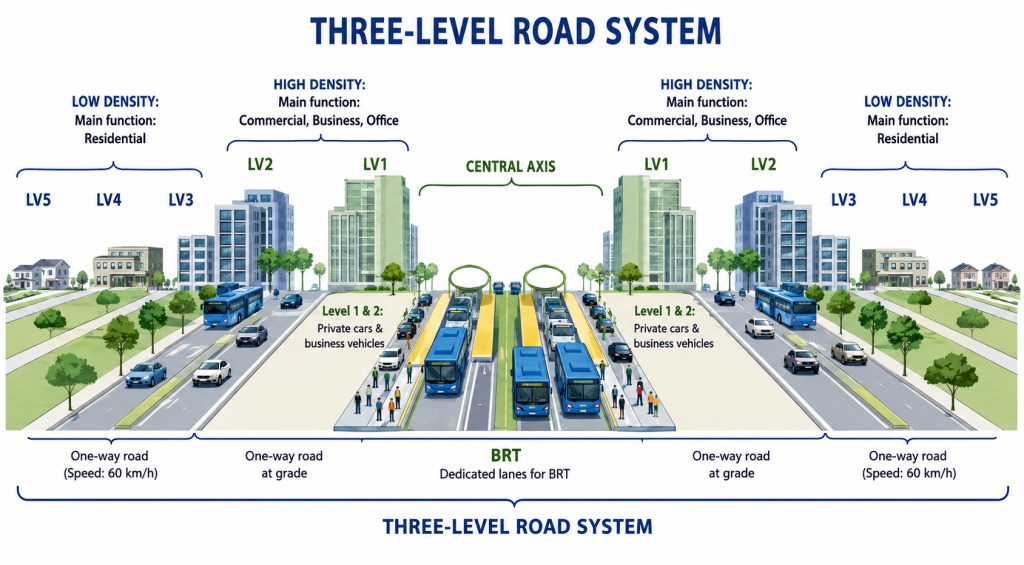
An integrated land database incorporating SEEA accounting collects data from digital cadastral maps, land parcel geometries, land registration records, transaction prices within 24 months, approved land-use plans, and urban development plans, thereby establishing a foundation for evaluating regional conditions.
The “value zone” and “standard parcel” methodologies are applied to build land pricing tables down to individual plots. Overlaying cadastral maps with land-space layers enables authorities to verify updates and assess data quality. Comprehensive land parcel characteristics — including area, shape, location, infrastructure access, and socio-economic conditions — support advanced statistical analysis.
Value zones are identified based on parcel characteristics, transportation networks, and proximity to administrative, commercial, educational, healthcare, park, and entertainment centers. These zones are visually represented on digital cadastral maps according to price ranges, enhancing transparency.
Standard parcels are selected based on the frequency of common characteristics, stable land-use purposes, clear legal boundaries, and complete legal status, serving as anchor points for comparison and price adjustment processes. Comparative ratio tables derived from statistical analysis help quantify the influence of each factor on land value.
Expert consultation, user surveys, and market transaction comparisons help refine valuation results and reduce discrepancies between adjacent parcels and neighboring value zones.
The entire process is digitized and integrated into a national land database linked with SEEA, LADM, and IFC, forming a comprehensive ecosystem for multidimensional spatial governance.
Integrating SEEA, LADM, and IFC for Natural Resource Valuation
The integration of SEEA, LADM, and IFC creates a foundation for identifying, modeling, and quantifying the value of resources within three-dimensional spatial systems linked to national development planning.
Governance of underground resources and subsurface spaces plays a key role in shaping growth models based on the circular economy and ensuring national energy security. Mineral extraction, groundwater use, and underground urban development provide major development opportunities but require sophisticated governance approaches based on data, standardization, and comprehensive valuation.
Mineral rights should be recognized as independent 3D spatial objects separate from surface land-use rights. Ore bodies exist as volumetric formations extending into the subsurface, with clear geological boundaries and defined extraction lifecycles. Modeling through IFC Geotechnical Strata enables mineral reserves to be represented as voxel-based volume elements directly connected to geological and extraction data.
Legally, LADM records mineral extraction rights as time-limited property rights layered beneath surface land parcels but constrained by extraction depth and area. This approach reduces conflicts of interest, increases transparency in licensing, and improves financial oversight.
Because mineral resources often lack active trading markets, SEEA proposes the Net Present Value (NPV) method based on future resource rents. Resource rent is calculated as extraction revenue minus intermediate costs, labor costs, depreciation, and standard capital returns. Asset values are updated according to global commodity prices and remaining reserves.
Integrated databases allow governments to monitor fluctuations in national resource value and adjust extraction taxes and licensing fees more fairly and efficiently.
Groundwater management also requires a shift from individual well-based approaches toward volumetric aquifer governance. Aquifers are treated as spatial systems with finite recharge capacities affected by extraction, climate change, and saltwater intrusion. Extraction rights should therefore be allocated based on annual allowable volumes tied to natural recharge rates.
IoT sensors measuring groundwater levels, salinity, and land subsidence can be integrated into digital twins to support real-time simulations and management.
Urban underground spaces create major opportunities for infrastructure, transportation, and logistics development. Spatial zoning by depth allows different economic functions to be allocated appropriately:
- Shallow layers for utilities and commercial connections
- Intermediate layers for underground parking and data logistics centers
- Deep layers for metro systems and security infrastructure
Underground space valuation must move beyond surface land pricing concepts. Discounted cash flow methods can determine value based on completed underground real estate values minus construction costs and investor returns. LADM stores depth-adjustment coefficients to support mass valuation of underground projects.
At the surface level, governance of forests and water ecosystems requires separating land-use rights from biological resource ownership. Timber ownership rights can be independently identified and modeled using IFC Vegetation standards to support traceability, carbon credit markets, and international trade compliance.
Forest valuation under SEEA includes both timber market value and ecosystem services such as carbon sequestration, soil retention, and water regulation. Water protection corridors are established as restricted-use spatial buffer zones whose value is determined through the replacement cost of artificial treatment systems.
Marine governance extends cadastral systems into multilayered marine environments involving overlapping rights over surface waters, water columns, and seabeds. LADM supports the registration of rights associated with changing boundaries caused by tides and coastal erosion.
Marine resource valuation is based on resource rents from fisheries and the value of marine-use rights for offshore renewable energy, reflecting the opportunity costs of excluded economic activities.
Low-altitude airspace and outer space are also emerging as new development frontiers. Digital flight corridors for drones are modeled as 3D spatial tubes and valued according to avoided transportation costs compared with traditional logistics systems.
Orbital positions and radio spectrum resources are registered within extended spatial data layers and valued according to scarcity and data-generation potential from satellites.
Remote sensing data increasingly serves as a critical input for land and resource governance.
Ultimately, the integration of SEEA, LADM, and IFC transforms land databases into national digital infrastructure supporting the data economy, digital economy, green economy, and circular economy. Fully identifying and valuing every spatial layer — from underground spaces to outer space — enables environmental costs to be internalized, improves resource allocation efficiency, and supports long-term sustainable development.
Assoc. Prof. Dr. Nguyen Dinh Tho
Institute of Strategy and Policy on Agriculture and Environment

Tác giả: Admin
Một thành viên của VSCE.